
Chiropractic care for whiplash
Get to the root of your whiplash
Also known as: Whiplash-Associated Disorder, Neck Sprain, Auto-Injury Neck Pain
If you were rear-ended, hit a patch of ice, or were in any collision — even a low-speed one — whiplash can leave your neck stiff, painful, and slow to heal if it doesn't get the right care early. At The Creek Chiropractic & Wellness in Battle Creek, Dr. Leatherman evaluates your cervical spine the same day, creates thorough documentation for your insurance company or attorney, and builds a drug-free recovery plan that restores full motion and prevents the chronic neck pain that so often follows an untreated whiplash injury.

The basics
Understanding whiplash
Patients from Battle Creek and the surrounding communities choose us after an accident because we combine effective treatment with the thorough documentation that auto-insurance claims and personal-injury cases require. Dr. Leatherman provides detailed, organized injury records, works directly with Michigan PIP carriers, and builds a recovery plan specific to your collision — not a one-size-fits-all whiplash protocol.
Whether your accident happened yesterday or your symptoms appeared days later, the right time to be evaluated is now. Visit our New Patient Special to get started, or book your exam online in under a minute.
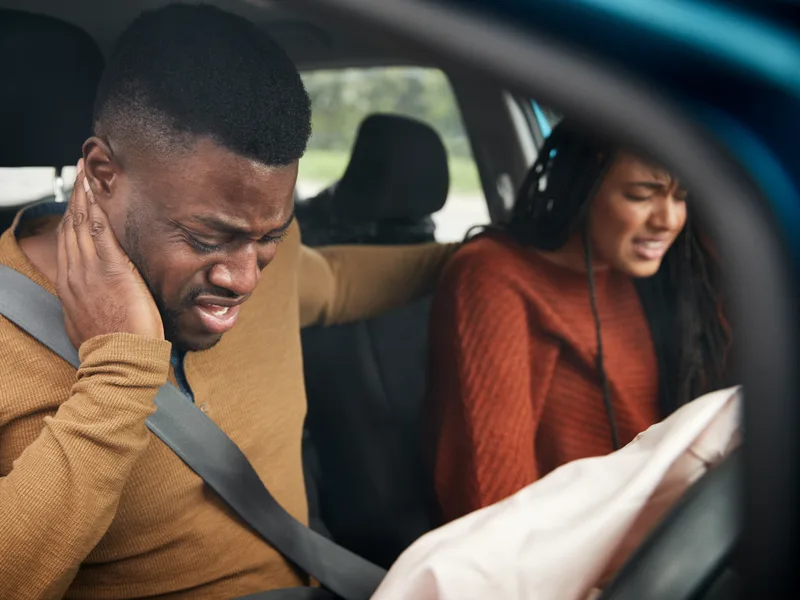
Whiplash happens when a sudden force — most commonly a rear-end collision — snaps the head rapidly forward and then backward, far exceeding the normal range of motion of the cervical spine. That violent acceleration-deceleration cycle stretches and tears muscles, ligaments, and joint capsules in the neck, and can also strain the discs and irritate nerve roots. The injury is graded on a spectrum from mild soft-tissue strain (Grade I) to fractures and neurological deficits (Grade III–IV); most patients fall into Grade I–II, where chiropractic care is among the most effective treatments available.
One of the most important things to understand about whiplash is that symptoms are often delayed. The rush of adrenaline after a crash masks pain, and the real stiffness, headaches, and restricted motion may not appear for 24–72 hours — sometimes longer. That delay leads many people to skip medical care, only to find themselves with chronic neck pain months later. Early evaluation, even when you feel "okay," creates a baseline record and starts gentle care before scar tissue and compensatory muscle guarding set in.
Who it helps
Symptoms of whiplash
Why it happens
Common causes
Types of whiplash injuries we treat
Whiplash is not a single, uniform injury. The structures damaged and the severity depend on collision speed, direction, head position, and individual factors. We regularly treat:
- Grade I–II cervical strain — the most common presentation; soft-tissue pain and restricted motion with no neurological deficit. Responds well to chiropractic adjustments, soft-tissue work, and corrective exercise.
- Cervicogenic headaches after whiplash — headaches that originate from the upper cervical joints and muscles, often one-sided, starting at the base of the skull.
- Whiplash-associated disc injury — the same force that strains muscles can bulge a disc or aggravate pre-existing disc disease; intersegmental traction may be added to the plan.
- Referred arm pain and nerve irritation — when facet joints or a disc compress a nerve root, pain, tingling, or weakness can radiate into the shoulder and arm (see neck pain with arm symptoms).
- Whiplash with upper-back involvement — many rear-end collisions also strain the thoracic spine and ribs, producing upper and mid-back pain alongside neck pain.
- Occupational or on-the-job accident whiplash — if the accident happened at work, we coordinate with workers’ compensation; see our work injury page.
When to see a chiropractor in Battle Creek
The most important thing to know: do not wait to see how you feel. Whiplash symptoms are notoriously delayed, often appearing 24–72 hours after the collision when adrenaline has worn off and inflammation has set in. By that time, muscle guarding and swelling are already working against healing.
Book an exam right away if you were in any collision — even a low-speed fender-bender — and especially if you notice:
- Stiffness or pain when turning or tilting your head
- Headaches at the back of your skull that were not there before the accident
- Aching or tightness across your shoulders or upper back
- Tingling, numbness, or a heavy feeling in your arms or hands
- Dizziness, difficulty focusing, or unusual fatigue
- Jaw pain or clicking that started after the collision
Red-flag warning: If you have severe pain with any neurological symptoms (loss of strength, loss of bladder or bowel control, or signs of a stroke), seek emergency evaluation immediately before chiropractic care. We screen for these findings on every first visit and will refer you without hesitation if warranted.
Drug-free whiplash recovery — without medication or surgery
The conventional response to whiplash — muscle relaxants, NSAIDs, and a cervical collar — addresses pain for a few days but does nothing to restore joint motion, repair soft tissue, or prevent chronic stiffness. Surgery is almost never indicated for Grade I–II whiplash.
Chiropractic care takes a different approach: gentle spinal manipulation restores normal movement to the facet joints of the cervical spine, reducing nerve irritation and breaking the pain-spasm cycle. Soft-tissue work and massage release the trigger points and adhesions that form in injured muscles. Corrective exercise rebuilds the deep cervical stabilizers that protect the spine from re-injury. The result is a neck that moves freely, hurts less, and holds up long-term — without drug dependency or surgical downtime.
If your exam ever reveals something that requires medication, imaging, or specialist referral, we will coordinate that care honestly and promptly.
Our approach
How we treat whiplash in Battle Creek

- Step 1
Thorough exam and documentation
We take a detailed history of the accident, perform orthopedic and neurological testing, and provide written documentation of your diagnosis and care — everything an insurance adjuster or personal-injury attorney needs.
- Step 2
A clear, personalized recovery plan
You leave your first visit knowing exactly what was injured, how long recovery typically takes, and the specific steps we'll take — adjustments, soft-tissue work, and corrective exercise — to restore your neck.
- Step 3
Progressive rehab and discharge
As pain and spasm settle, we layer in corrective exercises that rebuild cervical strength and stability, so the injury heals fully instead of leaving you with residual stiffness or recurring flare-ups.
Why choose chiropractic
Chiropractic care vs. the typical whiplash response
| Comparison factor | Chiropractic Care | Pain Meds & Surgery |
|---|---|---|
| Addresses the root cause | ✓Restores joint motion and heals soft tissue | ✕Masks pain temporarily |
| Drug-free and non-invasive | ✓Always | ✕Rarely |
| Insurance documentation | ✓Thorough written records provided | ✕Often minimal documentation |
| Risk of side effects | ✓Minimal | ✕Higher (dependency, surgical risks) |
| Restores range of motion | ✓Core focus of every visit | ✕Seldom addressed directly |
| Prevents chronic pain | ✓Early care dramatically reduces risk | ✕Long-term outcomes often poor |
Treatment options
Services we use to relieve whiplash
-
 Chiropractic Care Gentle, precise chiropractic adjustments in Battle Creek, MI that restore motion to restricted joints and relieve back pain, neck pain, and headaches at the source.
Learn more
Chiropractic Care Gentle, precise chiropractic adjustments in Battle Creek, MI that restore motion to restricted joints and relieve back pain, neck pain, and headaches at the source.
Learn more
-
 Therapeutic Massage Therapeutic massage in Battle Creek relaxes tight muscles, improves circulation, and complements chiropractic care for neck pain, whiplash, and tension headaches.
Learn more
Therapeutic Massage Therapeutic massage in Battle Creek relaxes tight muscles, improves circulation, and complements chiropractic care for neck pain, whiplash, and tension headaches.
Learn more
-
 X-Rays On-site digital X-rays in Battle Creek, MI, ordered only when clinically needed, with low-dose modern equipment and a plain-English review of your findings the same day.
Learn more
X-Rays On-site digital X-rays in Battle Creek, MI, ordered only when clinically needed, with low-dose modern equipment and a plain-English review of your findings the same day.
Learn more
Related conditions
Other conditions we treat in Battle Creek



I feel fine right after my accident — do I really need to be seen?+
Yes, absolutely. Whiplash symptoms are frequently delayed 24–72 hours as adrenaline masks pain. An early exam establishes a baseline record, catches subtle joint and ligament injuries before they stiffen, and creates documentation that is much harder to obtain after a gap in care.
How soon after a car accident should I see a chiropractor?+
As soon as possible — ideally within 24–72 hours. Early care produces better outcomes and creates a clear timeline for any insurance or legal claim. Waiting weeks can complicate both your recovery and your claim.
Will my auto insurance (PIP) cover chiropractic care after an accident?+
In Michigan, Personal Injury Protection (PIP) is required coverage and typically pays for chiropractic evaluation and treatment following a car accident with no out-of-pocket cost to you. We work directly with PIP claims and can help verify your benefits before your first visit.
Can I use the at-fault driver's insurance to pay for my treatment?+
Yes. If another driver was at fault, their liability coverage may cover your medical bills and related damages. We provide detailed diagnosis and treatment records that support personal-injury claims — many patients share these directly with their attorney.
Do I need an attorney for a whiplash claim?+
That depends on your situation. What we can tell you is that thorough, early medical documentation dramatically strengthens any claim. We provide organized records on request and are experienced working alongside personal-injury attorneys in the Battle Creek area.
My symptoms came on days after the accident — is it too late to come in?+
Not at all. Delayed symptom onset is a hallmark of whiplash and is well-recognized by insurers and courts. Come in as soon as you notice symptoms and we will connect them to the mechanism of injury with proper documentation.
How is whiplash different from regular neck pain?+
Whiplash involves a specific traumatic mechanism — the rapid snap of the head — that can injure multiple layers of tissue at once, including muscles, ligaments, facet joints, and discs. It often produces a cluster of symptoms (neck pain, headache, arm symptoms, dizziness) that differ from everyday [neck pain](/symptoms/neck-pain/) and may require a longer, more structured recovery.
How many visits will I need to recover?+
Mild to moderate whiplash typically resolves in 4–12 weeks of consistent care. After your exam, Dr. Leatherman gives you a specific, time-bound plan — not open-ended treatment — with milestones you can track.
Is chiropractic adjustment safe right after a whiplash injury?+
When imaging or red-flag screening rules out fracture or ligament instability, gentle chiropractic care is safe and recommended by evidence-based guidelines. We screen every patient before beginning treatment, and if we find anything that requires emergency evaluation or specialist referral, we tell you immediately.
Can whiplash cause long-term or chronic problems?+
Untreated or undertreated whiplash can lead to chronic neck pain, persistent headaches, and restricted motion that lasts years. Early, appropriate care — including soft-tissue treatment and corrective exercise — significantly reduces that risk.
Do you treat whiplash-related headaches and dizziness too?+
Yes. Cervicogenic headaches and whiplash-associated dizziness are common and stem from the same injured structures in the upper cervical spine. Restoring normal joint motion and reducing muscle tension in the neck usually resolves or dramatically reduces both — see our [headaches page](/symptoms/headaches-migraines/) for more.
Disclaimer: We do not diagnose or treat conditions, diseases, or symptoms. Our care is centered on improving the neuromusculoskeletal system by addressing spinal subluxations and the subluxation complex. Any improvement in overall health or function is the natural result of restoring proper spinal alignment and supporting the body's innate ability to heal itself. For medical diagnosis or treatment, please consult a licensed medical professional.